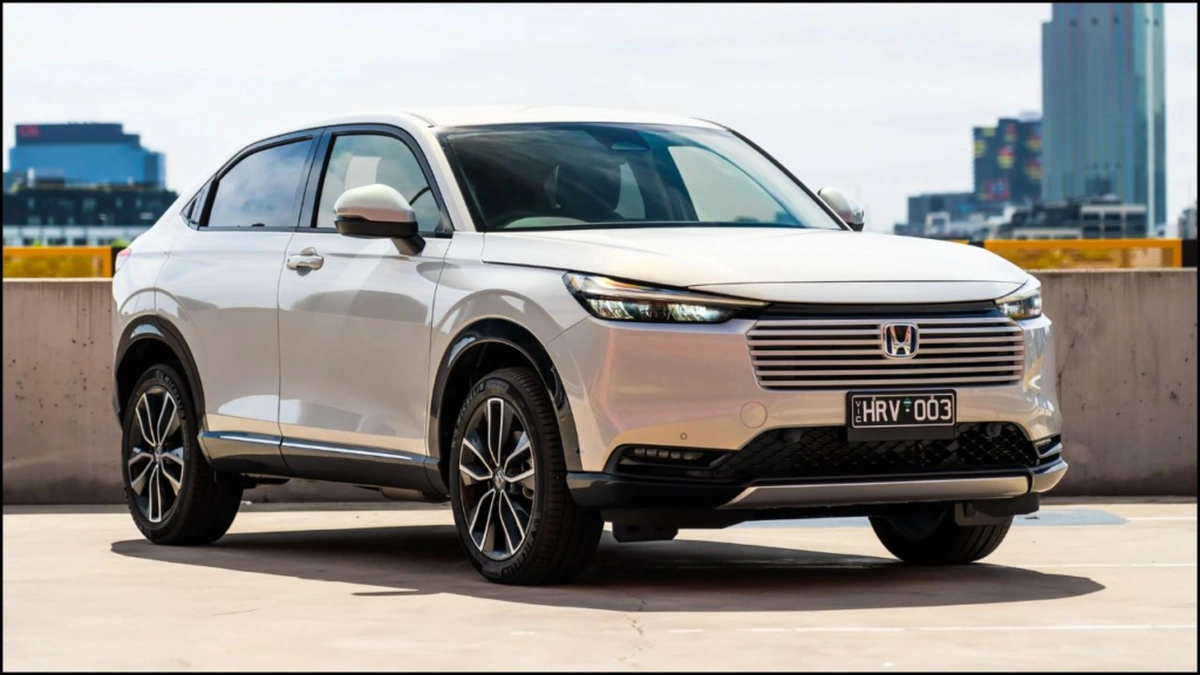
Honda has revealed its 2025 HR-V SUV, emphasizing a blend of hybrid efficiency and upscale amenities. While the European market enjoys this model exclusively as a hybrid, the U.S. market will still offer gasoline-powered options. Honda is still prioritizing the Elevate in India, leaving the HR-V out of the current plans.
Honda has unveiled the 2025 HR-V SUV, underscoring hybrid efficiency and premium features in its international offering. As a pivotal model in Honda’s global strategy, this compact SUV addresses the growing consumer demand for vehicles that prioritize fuel economy and comprehensive safety measures across Europe, North America, and various regions of Asia.
Table of Contents
- Hybrid Efficiency at the Centre
- Petrol Options Remain in Some Markets
- New Honda HR-V 2025 SUV Design and Styling
- New Honda HR-V 2025 SUV Technology and Connectivity
- Safety Remains Standard
- Environmental Impact and Honda’s Roadmap
- Consumer Reception and Early Reviews
- Competitor Landscape
- Market-Specific Strategy
- Future Outlook
- Conclusion
Hybrid Efficiency at the Centre
The 2025 Honda HR-V amplifies Honda’s commitment to electrification. Across Europe and the UK, the HR-V is exclusively available as a hybrid, utilizing Honda’s e:HEV system, which pairs a 1.5-litre gasoline engine with dual electric motors. This setup enables short-distance travel solely on electric power.
Honda’s official statements highlight that the hybrid model provides “the efficiency of an electric drive with the flexibility of a petrol engine.” Third-party assessments suggest a combined fuel efficiency of approximately 18–20 km/l in hybrid markets.
Petrol Options Remain in Some Markets
Within the United States, Honda will persist in selling the HR-V featuring a 2.0-litre four-cylinder gasoline engine generating 158 horsepower. Data sourced from Honda Motor America indicates a combined fuel economy of 27 miles per gallon.
Customers in Japan and Southeast Asia can choose between gasoline and hybrid configurations. However, the HR-V isn’t currently slated for launch in India. Honda is instead promoting the Elevate SUV, citing financial obstacles linked to importing or producing the HR-V locally. Market observers estimate that an HR-V launch in India would place it in the ₹10–15 lakh price range, thus rivaling competitors like the Hyundai Creta, Kia Seltos, and Maruti Suzuki Grand Vitara.
New Honda HR-V 2025 SUV Design and Styling
The updated exterior of the 2025 HR-V showcases Honda’s effort to attract younger demographics. The redesigned SUV incorporates a more imposing grille, sleeker LED headlights, and a coupe-like roofline. The rear styling boasts sharper taillights and a reshaped bumper, resulting in a more athletic appearance.
The interior incorporates upgraded soft-touch materials on the dashboard, a redesigned center console layout, and improvements to seating comfort. Enhanced trims will feature leather seating, ambient lighting systems, and dual-zone climate control functionalities.
New Honda HR-V 2025 SUV Technology and Connectivity
Technology is a focal point for the 2025 HR-V. Certain markets will receive a 9-inch infotainment touchscreen with Apple CarPlay and Android Auto compatibility. Higher specification trims include wireless smartphone integration and a digital instrument panel.
Honda has also expanded its connected services, enabling owners to remotely manage door locks, unlocking mechanisms, or starting the vehicle via a smartphone application, contingent upon the availability of these services in specific regions.
Safety Remains Standard
The 2025 HR-V comes standard with Honda SENSING®, the automaker’s advanced suite of driver-assistance technologies. This system features adaptive cruise control, lane-keeping assistance, traffic sign recognition software, and collision mitigation braking.
“The incorporation of advanced driver-assist features as standard reflects increasing customer expectations for safety enhancements alongside regulatory changes in Europe and North America,” noted Dr. Kenji Matsumoto, a leading automotive analyst with the Japan Automobile Research Institute.
Environmental Impact and Honda’s Roadmap
Hybrid SUVs like the HR-V represent a crucial intermediate step in Honda’s broader electrification strategy. The corporation intends to realize carbon neutrality for all product lines and business operations by the year 2050.
Honda’s sustainability reports state that the hybrid HR-V produces lower CO₂ emissions when contrasted with its petrol counterparts, thereby presenting a compliance-friendly solution amid tightening fleet emission guidelines in Europe. Experts posit that these vehicles will provide a bridge to the forthcoming large-scale launch of battery electric vehicles (BEVs), projected to pick up pace after 2026.
Consumer Reception and Early Reviews
Initial reviews from both U.S. and European automotive journalists underline the HR-V’s spacious cabin and comfortable ride experience. Critics, on the other hand, remark that the gasoline engine variant could use more power relative to some competitors.
In the UK, Auto Express magazine lauded the HR-V hybrid as being “a well-rounded family SUV, delivering solid fuel economy and dependable safety tech.” U.S. reviews took a slightly more measured tone, commending its practicality but questioning its performance at higher highway speeds.
Competitor Landscape
The HR-V faces competition within a particularly dense segment of the SUV market. Within Europe, rivals include Toyota’s Yaris Cross Hybrid and Hyundai’s Kona Hybrid, each having already garnered a strong market presence.
In India, if it were introduced, the HR-V would directly compete against the Hyundai Creta, Kia Seltos, Maruti Suzuki Grand Vitara, and Toyota Urban Cruiser Hyryder. These nameplates presently command the medium-sized SUV category, providing limited entry points for new competitors without substantially competitive price points.
“To find success in India, Honda would need to localize production and provide highly competitive pricing structures, a task made difficult by the HR-V’s global positioning,” articulated Rajiv Mehta, a seasoned auto editor at The Economic Times.
Market-Specific Strategy
Honda’s strategy for the HR-V is adapted to suit regional needs. Within Europe, a hybrid-only approach is a reflection of regulatory pressures. In North America, the prevalence of more affordable fuel keeps gasoline-powered models competitive. Honda leverages a combined strategy within Asia, balancing competitive cost alongside hybrid demand in metropolitan locations.
Honda’s existing plans do not include India. Honda executives have yet to announce a timeline for the vehicle’s introduction, emphasizing present commitment to the Elevate, City, and Amaze vehicles.
Future Outlook
Automotive insiders speculate that the HR-V could be offered in India if hybrid adoption rates rise and costs decline. Wider trends indicate compact SUVs will stay in demand, with hybrid tech acting as a viable step towards full electrification.
“The HR-V is essential to Honda’s worldwide SUV range,” stated Anil Sharma, a highly ranked senior analyst for the Nomura Research Institute. “Honda’s capacity to strike a good balance among cost, technology and ecological soundness will determine Honda’s competitiveness in both new and established economies.”
Honda CR-V 2025 SUV Launch with Luxury Features and Higher Mileage – Now Available at a Massive Discount!
Conclusion
The launch of the 2025 HR-V signals the company’s effort to strengthen its compact SUV segment with hybrid efficiency, premium features, and modern safety technology. Its dual strategy—hybrids in Europe and petrol models in the U.S.—illustrates Honda’s adaptation to regional realities. Whether the HR-V will enter India remains uncertain, but its global positioning reinforces Honda’s broader ambition to shift towards low-emission mobility while maintaining mass-market appeal.
