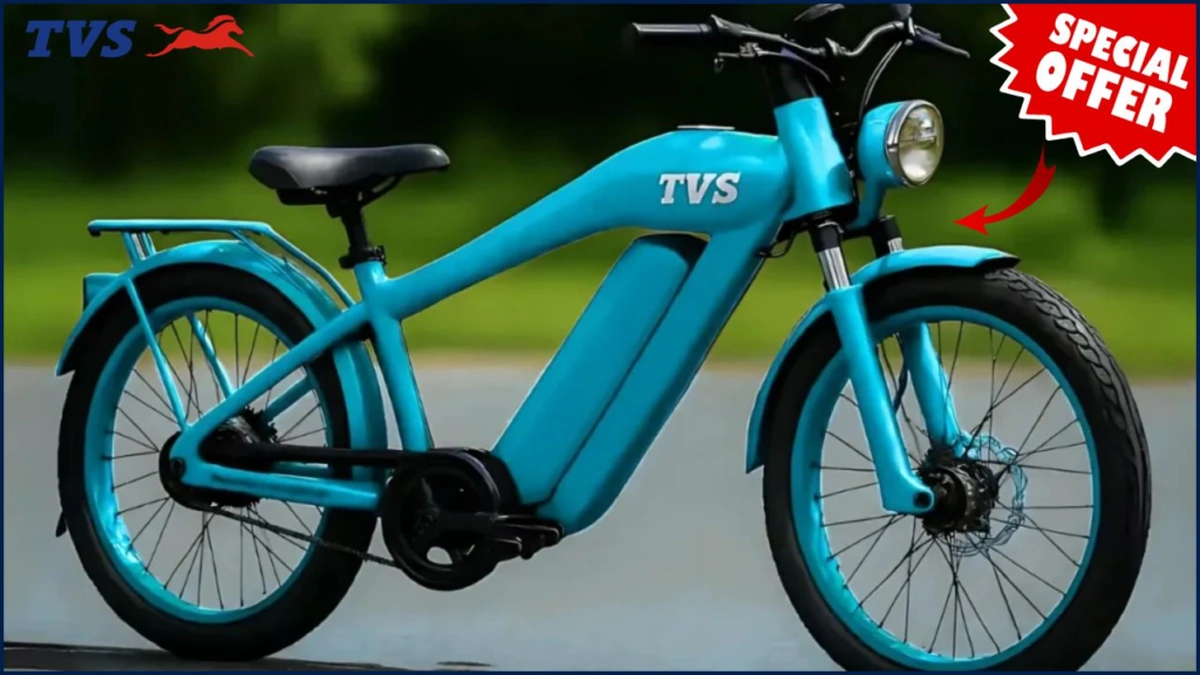
Unsubstantiated reports circulating online suggest that TVS might launch an Electric Cycle in 2025 for around ₹5,000, boasting an 80 km range and a top speed of 45 km/h. These claims have gained traction in India, however, industry insiders believe this price point is highly unlikely. TVS has not validated these claims, and authorities are advising the public to exercise caution regarding these reports.
The internet is buzzing with rumors about the TVS Electric Cycle 2025, supposedly launching in India with an impressive 80 km range and a 45 km/h top speed, all for a mere ₹5,000. This news has exploded across social media, garnering millions of views. Nevertheless, the TVS Motor Company hasn’t released any official statements to confirm this product, resulting in widespread skepticism from both industry professionals and consumer advocates.
Table of Contents
- No Confirmation from TVS Motor Company
- Claimed Specs Don’t Match Market Realities
- TVS and India’s Electric Mobility Evolution
- How India’s E-Bike Market Compares Globally
- The Role of Government Incentives
- Technical Reality Check: Why ₹5,000 Is Unrealistic
- Online Misinformation and Scam Risks
- Consumer Perspectives
- Scam Watch: How to Stay Safe
- Warning Signs
- Safety Measures
- Future of Affordable E-Bikes in India
- Conclusion
No Confirmation from TVS Motor Company
The rumor began with a popular Facebook post earlier this month, complete with promotional images and text advertising the incredibly low price. To date, TVS Motor Company has not confirmed or announced any electric cycle like this through their official communication channels.
A TVS spokesperson stated to a leading business publication on Monday, “Any announcements regarding our new electric offerings will be exclusively communicated through our official and verified platforms. We urge consumers to refrain from engaging with unverified links or advertisements.”
As a frontrunner in India’s two-wheeler industry, TVS has been actively growing its presence in the electric mobility sector, introducing models such as the TVS iQube and the groundbreaking TVS X.
Claimed Specs Don’t Match Market Realities
The viral claims suggest that the TVS Electric Cycle 2025 would offer the following:
- An 80 km range on a single full charge
- A top speed reaching 45 km/h
- A launch price of just ₹5,000
In comparison, most entry-level electric bicycles sold in India typically range from ₹30,000 to ₹50,000, and provide much lower performance capabilities. Dr. Rakesh Mehta, a senior researcher at the prestigious Indian Institute of Technology (IIT) Delhi, commented that “Even when factoring in government subsidies, a price of ₹5,000 is not economically viable. The cost of the battery pack alone would significantly exceed that amount.”
TVS and India’s Electric Mobility Evolution
TVS Motor Company’s journey into electric mobility began in 2020 with the introduction of the iQube Electric scooter, strategically positioned within the premium commuter market. Since then, the company has invested significantly in both advanced battery technologies and the establishment of charging infrastructure partnerships.
- 2020: Launch of TVS iQube in Bengaluru
- 2022: National expansion to major Indian cities
- 2023: Investment in battery R&D and supply chain localization
- 2024: Launch of the premium TVS X
- 2025: Viral claims of low-cost e-bike with no official basis
This progression highlights how a ₹5,000 product would be a considerable departure from TVS’s current pricing strategies.
How India’s E-Bike Market Compares Globally
In China, base model electric bicycles generally retail starting from ₹20,000 to ₹25,000, delivering limited speeds and range. Across Europe and in the United States, prices can easily climb above ₹80,000, driven by more stringent safety requirements and superior performance standards.
As reported in a 2025 study by the International Energy Agency (IEA), India ranks as the third-largest market globally for electric two-wheelers, surpassed only by China and Europe. However, achieving price reductions down to ₹5,000 remains unlikely due to the substantial costs of batteries, frame materials, and logistical operations.
The Role of Government Incentives
The Indian government’s Faster Adoption and Manufacturing of Electric Vehicles (FAME-II) initiative has been crucial in making e-bikes more affordable. Consumers have access to subsidies ranging from ₹7,500 to ₹20,000 depending on the e-bike model and its battery capacity.
However, automotive policy analyst Nidhi Sharma highlights that, “Even when taking into account the full FAME-II subsidy, a basic e-bike cannot realistically achieve a price point of ₹5,000. The costs associated with manufacturing, battery production, and mandatory certifications remain substantial.”
Technical Reality Check: Why ₹5,000 Is Unrealistic
This cost breakdown provides key insights into why experts widely consider the viral claim to be improbable.
Online Misinformation and Scam Risks
The claims about the TVS Electric Cycle 2025 have spread rapidly across Facebook, Instagram, and YouTube, often linking to unverified “pre-booking” websites. Consumer Affairs officials have cautioned the public against making any payments through these suspicious websites.
Scammers often use the branding and logos of well-known companies to trick consumers into fake pre-order schemes. Historically, numerous buyers have lost deposits without receiving any product.
Rajeev Sinha, a cybercrime investigator in Bengaluru, stated that “Scams such as these often spike whenever a reputable brand is involved. Consumers should only trust official company websites or verified dealers.”
Consumer Perspectives
Many consumers have expressed both skepticism and hope about the possibility of such an affordable product.
Rohit Verma, a college student in Lucknow, stated that “If TVS truly releases a cycle for ₹5,000, I would definitely buy it. But honestly, it sounds too good to be true.”
Authorized dealers have also reported an increase in customer inquiries. Manish Patel, an authorized TVS dealer based in Ahmedabad, stated, “We have received over 50 calls this week concerning this cycle. However, we have no knowledge of such a product in our current pipeline.”
Scam Watch: How to Stay Safe
Warning Signs
- Low-quality websites that contain grammatical mistakes
- Incredibly low prices and pressure tactics, such as “limited-time offers”
- Requests for upfront payment without providing formal receipts
- Suspicious URLs designed to mimic official brand websites
Safety Measures
- Always double-check new product announcements on the official TVS website
- Avoid sharing personal details or financial information with unknown vendors
- Report any questionable advertisements to the appropriate consumer protection services or cybercrime agencies
Future of Affordable E-Bikes in India
Affordable e-bike development is definitely progressing. Market analysts expect considerable price decreases in the coming 3–5 years due to:
- Advancements in lithium iron phosphate (LFP) and next-generation solid-state battery technologies
- Increasing localization of manufacturing and supply chains within India
- Continued government incentives and supportive state-level EV policies
- Continued expansion of shared mobility infrastructure
Anita Varma, a senior automotive journalist at The Economic Times, observed that “India is entering a new phase in its EV adoption journey, and cost reductions are inevitable as the market develops.”
Conclusion
The viral claim regarding a TVS Electric Cycle 2025, priced at ₹5,000 with an 80 km range and 45 km/h top speed, lacks credible verification and is economically unrealistic. TVS Motor Company has not officially acknowledged this product, and experts have expressed serious doubts about the price feasibility considering current market conditions and manufacturing expenses.
As India’s electric vehicle (EV) market advances, consumers should remain well-informed, rely on trusted sources, and protect themselves from potential scams. The promise of affordable electric transportation is on the horizon, but not at the speculative price widely shared across social media.
