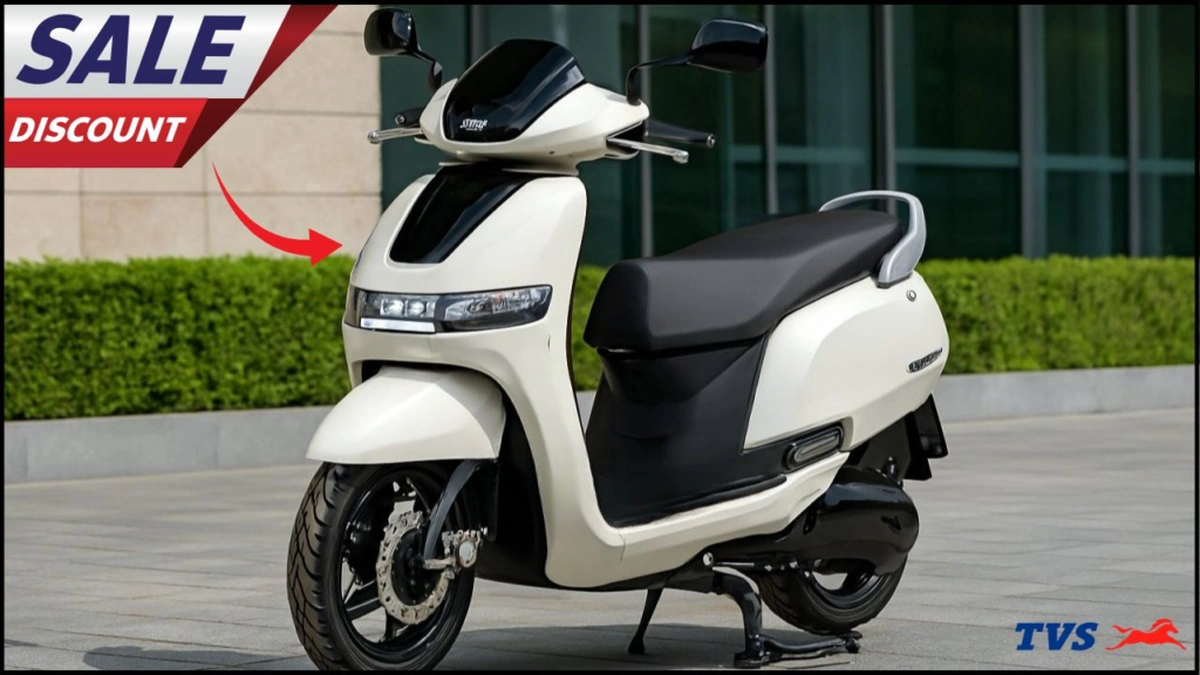
The latest TVS iQube Electric 2025 enhances India’s electric scooter options with a selection of four battery sizes, offering ranges of up to 212 km and advanced connectivity features. Despite some exaggerated claims circulating online, experts suggest that the scooter’s dependable design and reasonable pricing make it a significant contributor to India’s ongoing transition to electric vehicles.
The TVS iQube Electric 2025 has been officially launched, boasting a wider array of battery choices, an extended riding range, and improved digital capabilities. This launch highlights TVS Motor Company’s increasing focus on the competitive electric scooter market in India. Designed to offer up to 212 kilometers on a single charge, the model seeks to merge practical transportation with advanced connectivity within one of the world’s rapidly expanding EV markets.
Table of Contents
- New Battery Lineup and Realistic Range
- Pricing and Market Competition
- Design Evolution and Connectivity Features
- On-Road Performance and User Experience
- Technical Deep Dive: Battery and Safety
- Environmental and Economic Impact
- Policy and Infrastructure Support
- Consumer Sentiment and Early Sales
- Global Ambitions and Future Plans
- Addressing Online Misinformation
- The Road Ahead
- Conclusion
New Battery Lineup and Realistic Range
TVS Motor has released the 2025 iQube series with four distinct battery options: 2.2 kWh, 3.1 kWh, 3.5 kWh, and 5.3 kWh. This variety allows customers to select the best balance between range and cost to suit their needs.
The highest-end ST variant provides an IDC-certified range of 212 km, while the mid-tier models achieve between 100 and 145 km on a single charge. Charging durations differ depending on the model, requiring around four to five hours to reach an 80% charge when using the standard 950W home charger.
Company representatives have clarified that none of the current models support “1-hour fast charging” or a “520 km range,” which have been falsely advertised online. “We are committed to providing accurate performance metrics and ensuring rider safety above all else,” stated Manu Saxena, Senior Vice President for Electric Mobility at TVS.
Pricing and Market Competition
The 2025 range is priced starting at ₹99,741 for the entry-level version and goes up to approximately ₹1.60 lakh for the premium ST version (ex-showroom). This pricing positions TVS directly against competitors like Ola Electric’s S1 Pro, Ather 450X, and Bajaj Chetak.
According to data from the Society of Indian Automobile Manufacturers (SIAM), TVS had secured a 12% share of India’s electric scooter market by the middle of 2025, placing them behind Ola and Ather, but ahead of Hero MotoCorp’s Vida series. Experts anticipate that the broadened battery selection will enable TVS to attract new customers, especially in smaller cities.
“TVS’s strategy reflects a traditional approach for established manufacturers, emphasizing reliability, extensive service networks, and gradual improvements,” noted Dr Ananya Rao, Senior Researcher at the Energy and Resources Institute (TERI). “Instead of focusing on sensational figures, they are prioritizing long-term dependability.”
Design Evolution and Connectivity Features
While maintaining its recognizable form, the updated iQube includes subtle design enhancements such as a dual-tone seat, contrasting interior panels, and an optional backrest for higher-end models. The LED lighting system has been upgraded to improve visibility during nighttime rides.
Internally, technology takes center stage. Riders now have the option of selecting between 5-inch and 7-inch TFT displays equipped with touch controls, Bluetooth and 4G telematics, and turn-by-turn navigation via TVS SmartXonnect. This system supports over-the-air (OTA) updates, geo-fencing capabilities, and comprehensive ride analytics through a dedicated mobile application.
“We are shifting from conventional transportation to digitally integrated mobility,” Saxena explained during the launch. “The 2025 iQube offers a software-driven experience as much as it is a mode of transport.”
On-Road Performance and User Experience
The 5.3 kWh ST variant delivers a peak power output of 4.4 kW with 33 Nm of torque, allowing it to reach a top speed of 82 km/h. Reviews from automotive publications like Autocar India and Drivespark highlight improved throttle responsiveness, quieter motor operation, and effective braking performance.
The revised suspension setup enhances stability at higher speeds, while regenerative braking converts kinetic energy back into battery power. Real-world tests have shown ranges between 160 and 175 km under typical traffic and regular riding conditions—less than the official figures but in line with industry averages.
Riders also appreciate the generous under-seat storage, capable of holding a full-face helmet, and the enhanced seat comfort, making it ideal for urban commuting.
Technical Deep Dive: Battery and Safety
Each model utilizes lithium-ion battery packs managed by an intelligent Battery Management System (BMS) that optimizes temperature, charging rates, and cell equilibrium.
The system incorporates passive cooling and multi-layered thermal safeguards to minimize the risk of fire, a concern that has affected some EV manufacturers. The iQube also meets the stringent requirements of India’s AIS-156 safety standard, which mandates thorough testing for electric two-wheelers.
“Compliance with safety standards and sophisticated BMS are crucial for success in this market,” commented Ravi Kumar, Senior Analyst at Counterpoint Research. “Consumers are now much more aware of safety issues following recent incidents.”
Environmental and Economic Impact
Electric scooters such as the iQube offer significant reductions in emissions compared to traditional petrol-powered scooters. A study by the Council on Energy, Environment and Water (CEEW) indicates that each electric scooter can reduce up to 1.2 tonnes of CO₂ per year, based on India’s current electricity generation mix.
TVS estimates that converting 100,000 riders to electric vehicles could eliminate 120,000 tonnes of carbon dioxide annually. Furthermore, the running cost per kilometre for the iQube, approximately ₹0.15–₹0.20, is about one-sixth the cost of fuel for a petrol scooter.
“Electric mobility is not just a trend; it’s an economic necessity,” stated Priya Das, Fellow at the Centre for Policy Research. “With rising fuel costs and increasing pollution, EVs provide immediate benefits to both consumers and urban environments.”
Policy and Infrastructure Support
The iQube’s introduction aligns with the Indian government’s broader initiatives under the FAME-II (Faster Adoption and Manufacturing of Hybrid and Electric Vehicles) program, which has allocated over ₹5,000 crore in subsidies.
The National Electric Mobility Mission Plan (NEMMP) and new incentives at the state level—such as road tax exemptions in Tamil Nadu and purchase subsidies in Maharashtra—continue to promote EV adoption.
TVS has partnered with Jio-BP Pulse and Zeon Charging to expand the availability of public charging stations, claiming access to over 2,000 compatible chargers across 180 cities.
Consumer Sentiment and Early Sales
Dealers are reporting a strong initial response, with over 15,000 pre-orders placed within the first two weeks of its release, according to internal sources cited by The Hindu BusinessLine. Delivery times currently range from two to six weeks, depending on the specific model and geographic location.
Early user reviews praise the scooter’s build quality and intuitive software. However, some users have pointed out longer home charging times than expected and limited access to fast-charging facilities outside major metropolitan areas.
Global Ambitions and Future Plans
TVS Motor has announced plans to begin exporting the iQube to Indonesia, Thailand, and Nepal in 2026, marking its first major push into international EV markets. The company is also investing in a new battery assembly facility in Hosur, Tamil Nadu, with the aim of achieving 60% localization of components by 2027.
“Local battery production will be essential for ensuring India’s cost competitiveness,” noted Rajiv Kapur, Chairman of the Society of Indian Automobile Manufacturers’ EV Council. “TVS’s long-standing manufacturing expertise provides a significant advantage.”
TVS has also hinted at the development of a performance-focused iQube R concept, which could feature a more powerful motor and a liquid-cooled battery system.
Addressing Online Misinformation
Recently, social media posts have incorrectly stated that the iQube 2025 achieves a 520 km range and supports 1-hour charging. Both NDTV Auto and Drivespark have confirmed that these claims are not supported by official documentation or information on TVS’s official website.
Experts caution that such misinformation could erode consumer confidence in legitimate advancements in EV technology. TVS has announced that it is “actively working with digital platforms to address these false claims and maintain consumer trust.”
The Road Ahead
With the 2025 iQube series, TVS is solidifying its position as a traditional manufacturer effectively adapting to the digital age. While facing strong competition from emerging EV startups, the company’s emphasis on reliability, extensive service network, and continuous improvement provides a robust foundation for future growth.
India’s electric scooter market is projected to exceed six million units annually by 2030, according to ICRA Research. If TVS maintains its investments in software development, charging infrastructure partnerships, and battery research, it is well-positioned to be a leading player in shaping this future.
Conclusion
The TVS iQube Electric 2025 is a practical step forward in the evolution of electric vehicles in India. While not groundbreaking, it is dependable, safe, and tailored to consumer needs.
Although claims of a 520 km range and one-hour charging are unsubstantiated, the scooter’s verified range, strong construction, and connectivity features make it one of the most comprehensive electric two-wheelers currently available in India.
As India’s EV market continues to develop, models like the iQube demonstrate how established manufacturers can adapt responsibly, integrating technology with trustworthiness to guide the country toward a more sustainable transportation future.
