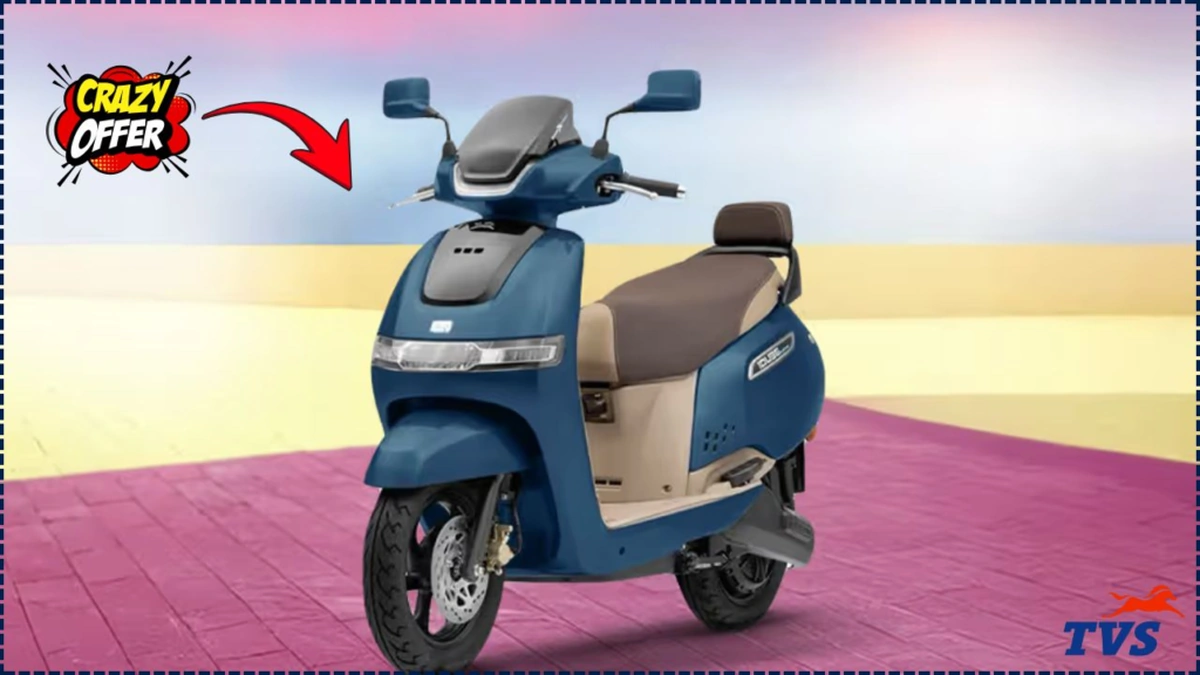
TVS Motor Company has revamped its TVS iQube Electric Scooter, integrating advanced smart connectivity features and touting a potential range of 410 km under controlled testing scenarios. Bolstered by reduced prices and national EV incentives, the scooter is set to solidify TVS’s position as a key player in India’s expanding electric mobility landscape.
TVS Motor Company has unveiled an enhanced lineup of its TVS iQube Electric Scooter, claiming a possible range of 410 kilometers on a single charge under controlled test conditions. This upgrade, along with notable price reductions, is designed to strengthen the manufacturer’s presence in India’s rapidly growing electric vehicle (EV) sector.
Table of Contents
- Expanding India’s Electric Two-Wheeler Market
- Pricing Strategy and “Bumper Sale” Incentives
- TVS iQube Electric Scooter Technical Overview: Range, Battery, and Performance
- Smart Mobility and Connectivity
- Environmental and Policy Impact
- Infrastructure Challenges and Expansion
- Global Context and Competitive Landscape
- Consumer and Dealer Perspectives
- Outlook and Conclusion
Expanding India’s Electric Two-Wheeler Market
The TVS iQube Electric Scooter was initially introduced to the Indian market in early 2020, marking the company’s initial step into electric mobility solutions. Over the past five years, TVS has established itself as a reputable EV brand in India, delivering a blend of performance, intelligent technology, and widespread service availability.
The 2025 update presents four fresh variants, showcasing improved battery technology, enhanced connectivity options, and refined riding comfort. According to TVS, the flagship iQube ST 5.3 kWh provides a claimed Indian Driving Cycle (IDC) range of 212 km, while a new experimental version, tested internally, has reached up to 410 km under ideal laboratory conditions.
Industry analysts suggest that the extended range figure is based on prototype performance. “The 410 km claim is based on meticulously controlled environments,” explained Ramesh Krishnan, an automotive researcher at the Indian Institute of Technology Madras. “In real-world riding situations, users can realistically expect between 180 km and 220 km, which is still competitive within its category.”
Pricing Strategy and “Bumper Sale” Incentives
To encourage greater adoption, TVS has launched a limited-time bumper sale, offering price reductions of up to ₹28,000 on selected models. According to Navbharat Times, this initiative is part of a nationwide festive campaign aimed at boosting end-of-year sales and reinforcing TVS’s position in the electric two-wheeler market.
The entry-level variant is now priced at approximately ₹1.10 lakh ex-showroom, while the ST model is priced between ₹1.45 lakh and ₹1.55 lakh, varying based on location and applicable state EV subsidies. In states like Maharashtra and Gujarat, further incentives can lower the final price.
TVS has also collaborated with leading financial institutions to provide zero-down-payment options and low-interest EMIs. “These actions position the iQube as an affordable EV choice for both city and suburban residents,” commented Anjali Sharma, an analyst at Motilal Oswal Financial Services.
TVS iQube Electric Scooter Technical Overview: Range, Battery, and Performance
The TVS iQube ST 5.3 kWh variant boasts a 7-inch TFT display, Bluetooth and Alexa integration, and geo-fencing for enhanced security. Its electric motor delivers 4.4 kW peak power, enabling acceleration from 0–40 km/h in just 4.2 seconds.
Charging solutions include a 650 W portable charger, capable of charging the battery from 0–80% in around 4.5 hours. TVS is also deploying a fast-charging network, allowing for a 0–80% charge in under 2 hours at designated locations.
As per TVS’s official specifications, the scooter’s regenerative braking system recovers up to 10% of kinetic energy during deceleration, while the enhanced battery casing design improves thermal management and safety.
Smart Mobility and Connectivity
The TVS SmartXonnect platform is standard across all new iQube models, delivering real-time diagnostics, remote battery status monitoring, navigation assistance, and ride statistics via a dedicated mobile app. Users can easily locate nearby charging stations and receive over-the-air (OTA) software updates.
“This new system makes the scooter feel more like a digitally connected device than just a traditional vehicle,” observed Priya Menon, editor at Auto Pulse India. “This level of digital integration is particularly appealing to younger, tech-focused consumers.”
Smart mobility has become a crucial factor in the Indian electric vehicle market, where consumer expectations increasingly mirror those of smartphone users—demanding seamless updates, cloud synchronization, and comprehensive support.
Environmental and Policy Impact
The growth of India’s EV sector is in harmony with government initiatives under the Faster Adoption and Manufacturing of Electric Vehicles (FAME-II) program. The central government provides subsidies of up to ₹15,000 per kWh of battery capacity, with many states offering additional benefits like tax exemptions and registration fee waivers.
Experts believe that widespread adoption of scooters such as the iQube could dramatically decrease India’s urban carbon emissions. According to The Energy and Resources Institute (TERI), every 1,000 electric two-wheelers that replace petrol equivalents can reduce nearly 36 tonnes of CO₂ emissions annually.
TVS has also announced a battery recycling initiative, partnering with specialized recycling firms to recover lithium, cobalt, and nickel for use in future battery production.
Infrastructure Challenges and Expansion
While long-range scooters are promising, India’s charging infrastructure still faces challenges. Major cities like Delhi, Bengaluru, and Pune have seen rapid deployment of charging points, but smaller cities and rural areas are lagging.
“Battery capacity alone isn’t enough to drive widespread adoption,” stated Dr. Meera Patel from the Energy and Resources Institute (TERI). “The accessibility and reliability of public charging stations are key to unlocking the full potential of these scooters.”
TVS intends to install over 2,000 public chargers across India by the end of 2026, working alongside energy providers such as Tata Power and Zeon Charging.
Global Context and Competitive Landscape
The global electric scooter market is highly competitive. Companies like China’s NIU and Europe’s Silence S01 offer models with ranges exceeding 200 km. In India, however, the market prioritizes cost-effectiveness and battery safety over maximum power output.
Within India, Ola Electric, Ather Energy, and Hero MotoCorp remain major competitors, each developing advanced battery systems and rapid-charging solutions. A report by NITI Aayog and the Rocky Mountain Institute predicts that electric two-wheeler sales in India will exceed five million units annually by 2030.
Maruti Wagon R 2025 Offer Blast! 32KM/L Mileage Hatchback with Big Discounts!
Consumer and Dealer Perspectives
Dealers report increased consumer interest in EVs, despite lingering concerns about charging infrastructure. Rohit Verma, a dealership manager in Bengaluru, noted, “Customers are now more confident. They see their neighbors using EVs daily, and they’re noticing that maintenance costs are much lower.”
Early adopters highlight smooth acceleration, silent operation, and minimal running costs as key advantages. Independent tests have shown running costs as low as ₹0.25 per kilometer—less than one-fifth the cost of a comparable petrol-powered scooter.
However, some buyers remain concerned about range anxiety and resale value. “The cost of battery replacements is still a significant concern for many,” said Anirudh Basu, an EV owner in Delhi. “If TVS were to offer extended warranties, it would provide greater peace of mind for long-term buyers.”
TVS Motor has announced the launch of the new TVS iQube series in three avatars that come loaded with best-in-class on-road range and a personalised connected experience like never before. #TVSMotorCompany #FutureMobility #EV @tvsiqube
Outlook and Conclusion
The TVS iQube Electric Scooter marks a significant technological and strategic advancement for the Chennai-based manufacturer. Combining extended range, competitive pricing, and advanced connectivity, it is poised to take advantage of India’s increasing shift towards smart mobility.
However, success will depend on consistent , reliable , and dependable after-sales support. As India accelerates towards its 2030 electrification goals, products like the iQube are crucial for reducing emissions, lowering fuel dependency, and transforming daily transportation across the nation.
