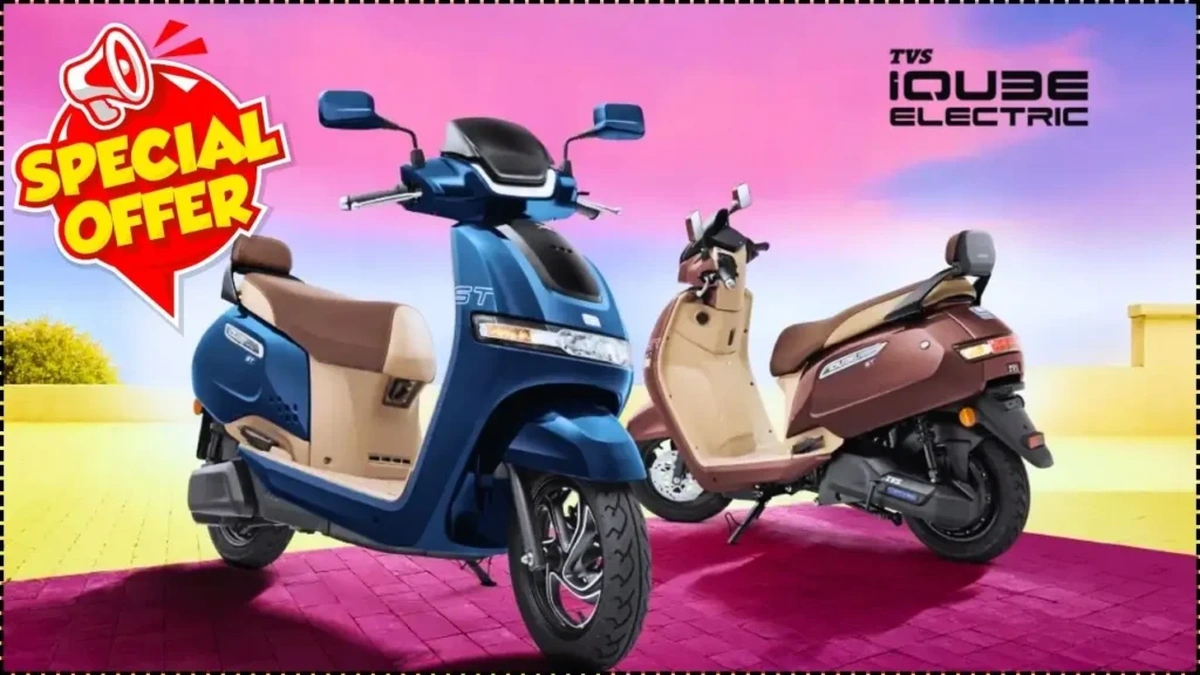
If that headline surprised you, you’re not alone. The idea of a TVS iQube achieving 545 km on a single charge, charging in an hour, and costing ₹55,000 seems amazing—but it doesn’t accurately represent the scooter’s official specifications, its real-world performance, or the current market pricing. The iQube series reaches a maximum certified 212 km (IDC) range on the ST 5.3 kWh model, and home charging uses a portable charger that takes several hours, not just one hour, to fully charge the battery. The 2025 pricing begins above ₹100,000 ex-showroom, based on the model and city. Therefore, this “bumper offer” and bold claims are likely just viral marketing or a promotional strategy, and should not be relied upon for making a purchase decision.TVS iQube Electric Scooter
The scooter’s official specifications show it’s built as a reliable city commuter with connected features and easy home charging, not a long-distance machine with rapid charging. The iQube series offers several battery options: a basic pack for short city trips, mid-range choices for added distance, and the top-tier ST 5.3 kWh model with the greatest certified range. Charging times vary based on battery size and charger power; the portable charger is designed for overnight or daytime charging, not DC fast charging. Even with incentives, expect modern EV-scooter prices, not a drastically low price.
Table of Contents
- TVS iQube Electric Scooter
- What’s Actually New For 2025
- Range And Charging Realities
- Variants And Who They Suit
- TVS iQube Electric Scooter Pricing, Subsidies, And The ₹55,000 Headline
- Features That Matter Every Day
- Buying Advice
- Is Claim Real?
- How To Evaluate Big EV Claims
- Who Should Buy The iQube
- FAQs on TVS iQube Electric Scooter
- What Is the Real Range of the TVS iQube ST?
- Does The TVS iQube Support 1-Hour Fast Charging?
- What Are The 2025 Prices For iQube S And ST?
- Which iQube Variant Is Best for City Commuting?
TVS iQube Electric Scooter
Official top IDC rangeTypical 0–80% chargingBattery options2025 price pointers (ex-showroom)Top speed (varies by variant)Charging methodConnected featuresUse case
Focus on the right details, not the eye-catching claims. The TVS iQube isn’t a miracle scooter with a 545 km range, 1-hour charge, and a ₹55,000 price tag. It’s a well-made urban EV with verifiable range, convenient home charging, and various models that are designed for Indian riding conditions. If you understand the difference between IDC and real-world range, realize that portable charging is for slow and steady charging, and get a confirmed on-road price from a dealer, you’ll get a scooter that meets your needs: a quiet, simple, and affordable option for daily use.
What’s Actually New For 2025
The iQube series received practical improvements focusing on usable range, connected technology, and convenience. The long-range ST model stands out, offering a certified 212 km IDC range, sufficient for city riders for multiple days of commuting with reasonable riding habits. The mid-range models (typically around 3–3.5 kWh) provide a good compromise between price and range, suitable for those who want to charge less often without needing the most expensive flagship model. The base models are great for short trips, offering light weight and quicker charging from low battery levels. Overall, the focus is on consistent and easy ownership, home charging, and a practical everyday range.
Range And Charging Realities
There are two key things to keep in mind. First, IDC range is a standard lab measurement, useful for comparing scooters but higher than real-world results. Actual range is affected by traffic, speed, hills, rider weight, and temperature. Second, portable chargers are designed for convenience and long battery life rather than maximum speed. This is why charging from 0–80% usually takes many hours, not just one; this supports daily use without requiring special charging stations. If you typically travel 30–50 km daily, charging overnight should be adequate. If you travel longer distances, plan for charging periods instead of expecting fast DC charging.
Your TVS iQube, now on your wrist.
The TVS iQube Noise Smartwatch is here. And with it, TVS iQube becomes India’s first electric scooter with smartwatch integration.
Head to our website to get yours! pic.twitter.com/I5B09kBWtj
Variants And Who They Suit
- Entry Battery (around 2.2 kWh): Ideal for short city commutes, delivery routes, and predictable routines with easy charging at home or the office. Its lighter weight, quick response, and faster charging from low levels make it simple to use in busy urban areas.
- Mid Battery (around 3.1–3.5 kWh): The best choice for most buyers. Offers a noticeable increase in IDC range, more distance for trips between suburbs and the city, and fewer charging stops. It performs well for those switching between Eco and Power modes and occasionally riding on highways.
- ST 5.3 kWh: The model with the greatest range, claiming 212 km IDC, designed to reduce range anxiety if your daily travel varies. This is ideal for riders doing many trips, occasional errands across town, or those wanting the longest range without managing the throttle closely.
TVS iQube Electric Scooter Pricing, Subsidies, And The ₹55,000 Headline
The 2025 prices for the iQube are well above ₹55,000. Even with government EV incentives, the ex-showroom prices for standard models are high enough that a price below ₹60,000 usually indicates a booking amount, a heavily advertised local deal with restrictions, or an inaccurate price for the specified model. Always check the details: ex-showroom price, insurance, registration, fees, charger cost (if separate), and any accessory packages. Confirm your eligibility for state subsidies and when they will be applied. Get a written on-road quote and compare with at least two dealers to prevent surprises.
Features That Matter Every Day
The iQube series focuses on features that riders use every day. Expect a connected display with navigation, call/SMS notifications, remote charging status, distance to empty, trip information, and over-the-air updates depending on the model. The design is comfortable for families, with storage that easily fits daily items. Top speeds of around 75–82 km/h are suitable for city expressways and highways while preserving battery life. The brakes and suspension are tuned for Indian roads—reliable and predictable across various conditions. As a result, this EV fits into your daily life without requiring much planning.
Buying Advice
- Informational intent: If you’re just learning, concentrate on the differences between models (battery size, display, features), IDC versus real-world expectations, and realistic charging times. IDC is a standard; your real range will depend on your riding.
- Transactional intent: If you plan to buy soon, choose two models based on your daily mileage. Most city riders will prefer the 3–3.5 kWh model; those who ride long distances or want maximum range should consider the ST 5.3 kWh. Get on-road prices, schedule test rides, and inquire about charger options and delivery schedules.
- Navigational intent: To find official details, go to the manufacturer’s pages for models, options, and pricing. Check an established auto website for a quick comparison. Confirm availability and color options in your city, as deliveries can vary.
Is Claim Real?
TVS iQube Electric Scooter with 545 KM Range & 1-Hour Fast Charge: Bumper Offer at ₹55,000—continues to be popular, probably because it gets attention. However, it doesn’t reflect the manufacturer’s listed range and charging capabilities, or the market price for 2025 models. Consider it a warning about validating EV claims: long range and fast charging usually require large batteries, high-voltage systems, and specialized charging. Scooters designed for Indian cities, with portable home charging and good after-sales service, are built around different priorities: dependability, convenience, and overall ownership cost.
How To Evaluate Big EV Claims
- Check the model name and battery size. A “range” claim without details about the battery is not helpful.
- Check for details on the test method (IDC versus real world) and charger type/power. Claims of one-hour charging often require specific equipment.
- Confirm if the stated price is for booking, ex-showroom, or on-road. Ask for a full price breakdown.
- Review warranty terms for the battery and the presence of service locations in your area.
- Evaluate your actual daily usage. If you ride 35–60 km per day, a mid-sized battery with overnight charging is often the best option.
Honda Activa Electric Scooty with 485KM Range and Fast Charging Introduced at ₹68,000- Exclusive Launching Deals
Who Should Buy The iQube
If your priority is predictable performance, low running costs, and a reliable service network, the iQube is a good choice. Base models are suitable for riders in compact cities who want low costs and easy charging. The 3–3.5 kWh model provides a good balance: less frequent charging, flexible weekend trips, and robust features. The ST 5.3 kWh model is the top option for those who want a large range, minimal anxiety about battery life, and advanced technology. Overall, you’re choosing a scooter designed for daily convenience, not for setting records.
FAQs on TVS iQube Electric Scooter
What Is the Real Range of the TVS iQube ST?
Expect the claimed maximum of 212 km IDC to be less in real-world conditions. You’ll get closer with gentle acceleration, city speeds, and good conditions, but less with higher speeds and heavier loads.
Does The TVS iQube Support 1-Hour Fast Charging?
The iQube uses a portable charger for home charging, requiring several hours for a full charge, not one hour. Plan for overnight or daytime charging, which works well for city commuting.
What Are The 2025 Prices For iQube S And ST?
Ex-showroom prices for 2025 usually start around ₹100,000 for S models and are higher for the ST 5.3 kWh. Final on-road costs vary based on city, insurance, and accessories.
Which iQube Variant Is Best for City Commuting?
For most riders, a mid-sized battery around 3–3.5 kWh balances cost and range for typical daily travel of 40–70 km. Choose the ST 5.3 kWh if you want maximum range and less frequent charging, or the base model for short, predictable city trips.
