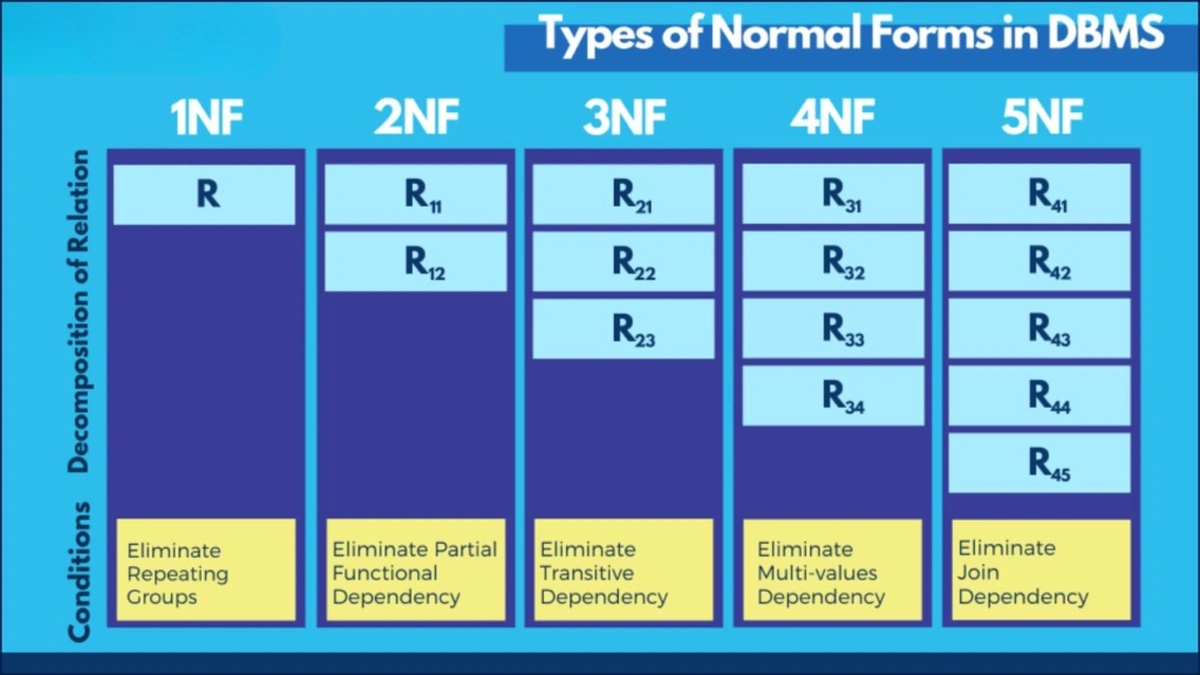
Database normalization, using concepts such as 1NF, 2NF, 3NF, and BCNF, is essential for minimizing data duplication and ensuring data accuracy in relational databases. By following these guidelines, database systems become more effective, dependable, and adaptable.
Database normalization is a vital concept in database management systems (DBMS) that seeks to reduce data redundancy and dependency by organizing data effectively. This involves transforming data into different normal forms, including First Normal Form (1NF), Second Normal Form (2NF), Third Normal Form (3NF), and Boyce-Codd Normal Form (BCNF). Each of these forms contributes to enhanced data integrity and eliminates unnecessary duplication.
Table of Contents
- What Is Database Normalization?
- Key Normal Forms in Database Normalization
- First Normal Form (1NF)
- Second Normal Form (2NF)
- Third Normal Form (3NF)
- Boyce-Codd Normal Form (BCNF)
- Why Is Database Normalization Important?
- Conclusion
What Is Database Normalization?
Database normalization is the process of organizing data within a database to minimize redundancy, enhance data integrity, and ensure effective data storage. The aim is to create a structure where each piece of data resides in the appropriate table, reducing the potential for inconsistencies and errors. By adhering to normalization rules, databases become more manageable, scalable, and resistant to errors during data operations.
Key Normal Forms in Database Normalization
First Normal Form (1NF)
Definition:
A table is in 1NF when it meets the following requirements:
- All columns contain atomic values (i.e., no multiple values within a single column).
- Each column contains values of a uniform type.
- Each row is unique, meaning there are no identical rows.
Example:
Consider a table listing student courses:
The “Courses” column violates 1NF because it contains multiple values. To transform this table into 1NF, we would divide each course into its own row:
Now, each cell contains a single value, meeting the requirements for 1NF.
Second Normal Form (2NF)
Definition:
A table is in 2NF if it is in 1NF, and all non-key attributes are fully dependent on the entire primary key. This means there is no partial dependency (where a non-key attribute depends only on a portion of a composite primary key).
Example:
Consider a table with the following structure:
Here, “Instructor” and “InstructorPhone” depend solely on “CourseID” rather than the complete primary key (“StudentID, CourseID”). To address this, we break the table into two:
- StudentCourses Table: StudentIDCourseID1M1011E1022M101
- Courses Table: CourseIDInstructorInstructorPhoneM101Dr. Smith123-456E102Dr. Johnson789-012
Now, all non-key attributes are fully dependent on the primary key, satisfying the requirements for 2NF.
Third Normal Form (3NF)
Definition:
A table is in 3NF if it is in 2NF and there is no transitive dependency. This means that non-key attributes should not depend on other non-key attributes.
Example:
In this example, “InstructorOffice” depends on “Instructor” rather than directly on the primary key. To correct this, we create another table for instructors:
- StudentCourses Table: StudentIDCourseID1M1011E1022M101
- Courses Table: CourseIDInstructorM101Dr. SmithE102Dr. Johnson
- Instructors Table: InstructorInstructorOfficeDr. SmithRoom 101Dr. JohnsonRoom 102
Now, “InstructorOffice” depends only on the “Instructor” and not on any other non-key attribute, satisfying the requirements of 3NF.
Boyce-Codd Normal Form (BCNF)
Definition:
A table is in BCNF if it is in 3NF, and every determinant is a superkey. A determinant is an attribute or a set of attributes that uniquely determines another attribute.
Example:
Consider this table:
Here, “Instructor” determines “InstructorPhone,” but “Instructor” is not a superkey. To fix this, we divide the table into two:
- Courses Table: CourseIDInstructorInstructorPhoneM101Dr. Smith123-456E102Dr. Johnson789-012
- StudentCourses Table: StudentIDCourseID1M1011E1022M101
Now, each determinant is a superkey, satisfying BCNF.
Why Is Database Normalization Important?
Database normalization is critical for ensuring data integrity, preventing errors, and optimizing performance in large-scale database systems. By following the normalization process, organizations can:
- Minimize Data Redundancy: Avoid duplicate entries and the associated risk of inconsistencies.
- Improve Query Performance: By organizing data into smaller, well-defined tables, query execution becomes quicker and more efficient.
- Maintain Data Integrity: With normalization, relationships between tables become clear, simplifying the process of maintaining and updating the database.
Conclusion
Database normalization is a fundamental practice in relational database design, ensuring that data is stored efficiently and that the risk of anomalies is minimized. The progression from 1NF to BCNF offers a systematic approach to organizing data, leading to improved data integrity and performance. By understanding these normal forms, database administrators can design systems that are efficient and scalable, ensuring reliable data management for the future.
