
 By Indiansciencemonitor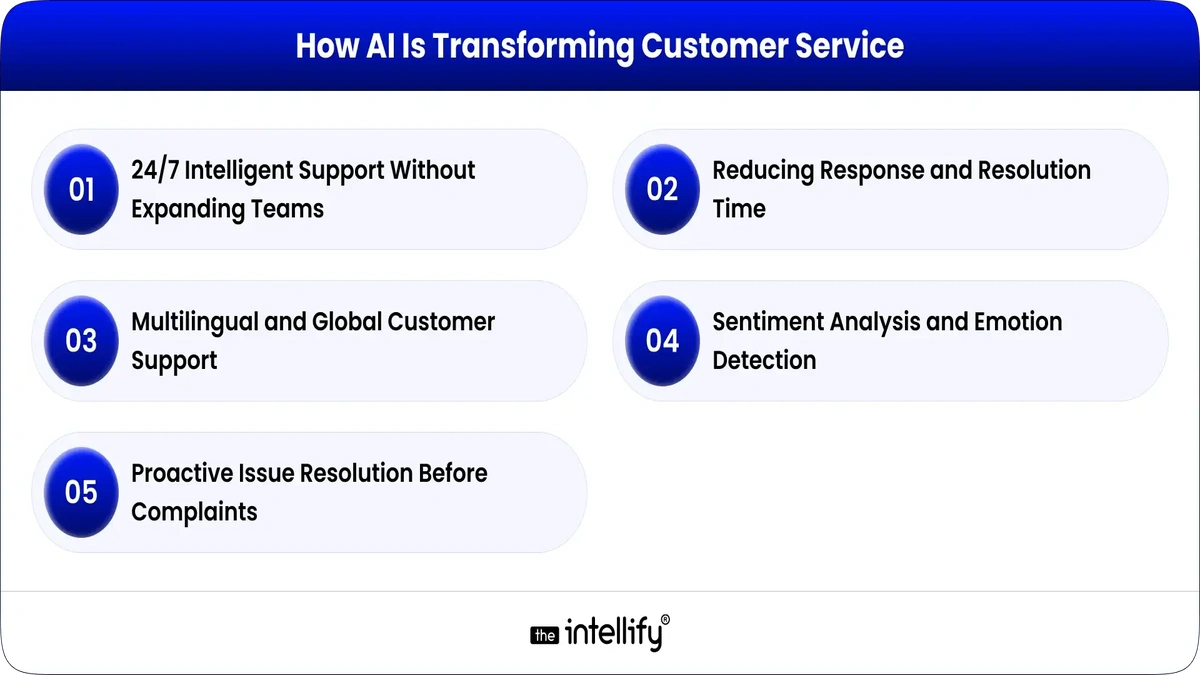
Remember those endless hold music sessions? The frustration of explaining your issue for the fifth time to a new agent? Yeah, we’ve all been there. It’s enough to make you want to throw your phone across the room, isn’t it? Well, what if I told you that the very fabric of how companies interact with us, their customers, is undergoing a quiet, yet absolutely monumental, transformation?
Here’s the thing: Artificial Intelligence (AI) isn’t just some futuristic concept anymore; it’s actively reshaping customer support and service, right here, right now. And it’s doing so in ways that go far beyond just those ubiquitousAI chatbotswe all encounter. This isn’t merely about automating simple tasks; it’s about a profound shift in how businesses understand, anticipate, and respond to our needs. The ‘why’ behind this revolution is what truly fascinates me, and it’s what we’re going to unpack today. Prepare to see customer service through a whole new lens.
Beyond the Bots | The “Why” Behind AI’s Ascent in Customer Experience (CX)
Let’s be honest, the traditional customer service model was, for lack of a better word, often broken. Long wait times, inconsistent advice, and a general feeling of being just another ticket in a queue. So, why are companies suddenly scrambling to integrate AI? It’s not just a fancy trend or a pursuit of efficiency, though that’s certainly a part of it. The deeper reason lies in our own evolving expectations as consumers.
We live in an instant gratification world. We expect 24/7 availability, immediate answers, and highly personalized interactions. The old models simply can’t keep up. This is where AI steps in, not as a replacement, but as an enabler. It’s helping businesses meet these sky-high demands, offering not just speed, but also a level of personalization that was previously impossible at scale. The entirecustomer experience (CX)is being re-imagined from the ground up, with AI acting as the central nervous system. This is the hidden context: AI isn’t just about cutting costs; it’s about surviving and thriving in a competitive landscape where customer loyalty hinges on exceptional interactions.
We often think of AI chatbots as the poster children of this transformation, and while they play a vital role in handling routine queries and deflecting calls, they are truly just the tip of the iceberg. The real magic happens behind the scenes, where complex algorithms are hard at work, making every interaction smoother and more intelligent.
The Mechanics of Change | How AI is Reworking Every Touchpoint
So, how exactly is this happening? It’s a multi-faceted approach, integrating various AI capabilities to create a seamless, responsive ecosystem:
1. Automation in Customer Service: The Smart Heavy Lifter
AI is taking over repetitive, rule-based tasks, freeing up human agents for more complex issues. Think about automatic ticket categorization, routing queries to the right department, or even resolving simple queries without any human intervention. Thisautomation in customer servicedrastically reduces resolution times and improves response rates. It’s like having an army of highly efficient virtual assistants working tirelessly in the background.
2. Predictive Analytics: Anticipating Your Needs
This is where things get really fascinating. AI can analyze vast amounts of data – your past interactions, purchase history, browsing behavior – to anticipate what you might need before you even know it. Imagine your internet provider proactively reaching out to fix a potential service disruption before it affects you, or an e-commerce site suggesting relevant products based on intricate patterns. This proactive support, driven by predictive analytics , isn’t just convenient; it builds immense trust and fosters loyalty.
3. Virtual Assistants & Voice AI: Your Ever-Present Guide
Beyond text-based chatbots, advanced virtual assistants powered by natural language processing (NLP) are revolutionizing voice channels. They can understand nuanced queries, context, and even emotional tone. This means more intelligent IVR systems that can actually solve problems, rather than just endlessly loop you through options. These systems are constantly learning, becoming more sophisticated with every interaction.
4. Omnichannel Support: A Cohesive Experience
Have you ever started a conversation on chat, then had to repeat everything when you switched to a phone call? Frustrating, right? AI enables true omnichannel support by ensuring that all your interactions, across different channels (chat, email, phone, social media), are seamlessly connected and informed by your complete history. It’s about creating a single, consistent journey, no matter how you choose to connect. This is vital for enhanced customer satisfaction , as it makes every touchpoint feel personal and efficient.
5. Human-AI Collaboration: The Best of Both Worlds
Perhaps the most crucial aspect is the partnership between humans and AI. AI isn’t taking over entirely; it’s empowering human agents. AI can provide agents with real-time customer data, suggest responses, and handle routine inquiries, allowing human agents to focus on complex, empathetic problem-solving. This human-AI collaboration ensures that while speed and efficiency soar, the human touch, so vital for delicate issues, remains firmly in place. It’s about augmenting human capability, not replacing it entirely.
The Real Impact on Businesses and Consumers in India
In a dynamic market like India, where customer expectations are soaring and digital adoption is rapid, the stakes are incredibly high. For businesses, the benefits of embracing AI in customer service are clear:
- Operational Efficiency: AI significantly reduces the burden on human agents, cutting down on operational costs and allowing companies to handle a much higher volume of queries without compromising quality. This translates directly into tangible AI customer service benefits.
- Personalization at Scale: Indian consumers, much like their global counterparts, appreciate personalized experiences. AI allows companies to offer tailored product recommendations, specific offers, and proactive support that makes each customer feel valued, not just another number.
- AI in Call Centers: This is a game-changer. AI-powered tools assist agents by pulling up relevant information instantly, transcribing calls, performing sentiment analysis, and even suggesting next best actions. This boosts agent productivity and leads to faster, more accurate resolutions.
- 24/7 Availability: In a country with diverse time zones and a round-the-clock economy, AI ensures that customer support is always available, anytime, anywhere. This is a massive advantage for businesses operating across different regions and caters to varying customer schedules.
However, it’s not without its challenges. There are legitimate concerns around data privacy, the ethical implications of AI, and potential job displacement. These are not minor footnotes; they are critical considerations that need careful navigation. The future of customer support will depend not just on technological advancement, but also on thoughtful implementation that prioritizes both efficiency and human values. Just as the automotive world looks to innovation with concepts like the2026 Fiat motorhome, businesses are charting new territories in customer interaction.
Is Your Favourite Brand Ready? Understanding AI Customer Service Examples
You’re probably already interacting with AI-powered customer service more than you realize. Think about your banking app’s chat feature, the instant responses you get from e-commerce sites, or even the virtual assistants on your telecom provider’s website. These are all AI customer service examples in action.
What differentiates good AI support from bad? The former feels helpful, intuitive, and genuinely solves your problem or directs you efficiently. The latter feels like a frustrating loop of canned responses, often misunderstanding your query. This largely depends on the sophistication of the customer service automation tools a company employs and, crucially, how well they are integrated with human oversight.
Artificial Intelligence(AI) itself is a vast field, but its application in customer service is truly coming into its own. Companies that invest in robust AI models, continuous learning, and a clear understanding of their customer journey are the ones excelling. They understand that AI isn’t a magic wand; it’s a powerful tool that, when wielded correctly, can elevate the entire service experience to unprecedented levels.
Frequently Asked Questions About AI in Customer Support
What is AI customer service?
AI customer service involves using artificial intelligence technologies like machine learning, natural language processing, and automation to enhance or automate various aspects of customer interactions, from initial inquiries to complex problem resolution.
Will AI replace human customer service agents?
Not entirely. While AI excels at handling routine, repetitive tasks and providing instant information, human agents remain crucial for complex problem-solving, empathetic interactions, and situations requiring nuanced understanding or creative solutions. It’s more about human-AI collaboration than outright replacement.
How does AI improve customer experience (CX)?
AI improves CX by providing 24/7 availability, reducing wait times, offering personalized interactions, enabling proactive support through predictive analytics, and ensuring seamless transitions across different communication channels.
What are the main benefits of AI in customer support for businesses?
For businesses, the primary benefits include increased operational efficiency, reduced costs, higher customer satisfaction, improved agent productivity, and the ability to scale support services without proportional increases in staffing.
Are there any downsides or challenges to using AI in customer service?
Yes, challenges include ensuring data privacy and security, overcoming customer resistance to interacting with bots, the need for continuous training and refinement of AI models, and addressing ethical considerations related to AI decision-making. Initial setup costs and integration complexities can also be factors.
Can small businesses use AI for customer support?
Absolutely! Many affordable and scalable AI-powered tools are now available, from simple chatbots to advanced automation platforms, making AI accessible even for small and medium-sized businesses looking to enhance their customer service without a massive investment.
The New Era of Service | It’s Personal, It’s Proactive, It’s AI-Powered
So, what’s the big takeaway? AI isn’t just a fancy add-on; it’s the engine driving a fundamental redefinition of customer support and service. It’s moving us from reactive problem-solving to proactive anticipation, from generic responses to deeply personalized interactions, and from fragmented experiences to seamless journeys. This isn’t just about technology; it’s about building stronger, more responsive relationships between brands and their customers.
The next time you interact with a company, pay attention. Chances are, a sophisticated network of AI customer service automation tools is working tirelessly behind the scenes, ensuring your experience is smoother, faster, and perhaps, even a little bit magical. The future of customer service isn’t coming; it’s already here, and it promises a world where frustrating interactions become a relic of the past. And honestly? That’s a future I’m genuinely excited about.